What does a sewer camera inspection show?
It shows the inside of the pipe — roots, buildup, scale, cracks, offsets at joints, standing water, changes in pipe material, and whether an obstruction appears cleared. What it cannot show is anything outside the pipe, anything beyond a blockage it cannot pass, or proof that a line is structurally sound. Both halves of that matter, and the rest of this page covers each.
The same service is often called a sewer scope, a sewer line camera inspection or a sewer video inspection. They describe the same thing.
What a sewer camera inspection is
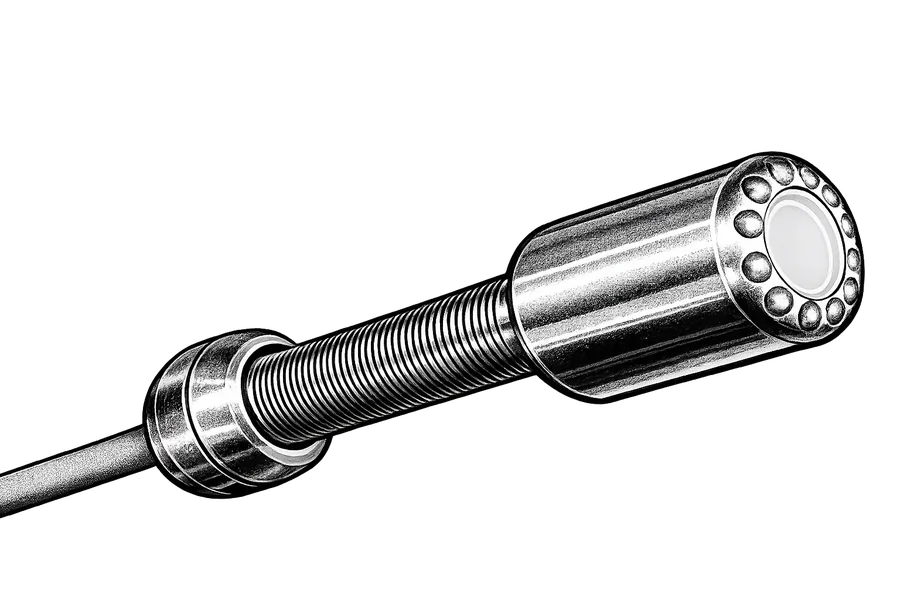
A waterproof camera on a flexible push rod is fed into the drain line through an access point and advanced along the pipe. The view is watched live on a monitor as the head travels, so the interior of the line can be examined directly rather than inferred.
It is a useful thing to be able to do anywhere, and particularly so across Brooklyn, where a great deal of the housing stock predates the pipe materials now taken for granted. An older line's condition is genuinely unknown until somebody looks.
It is a straightforward idea, and most of its value comes from that directness. Instead of reasoning about a line's condition from how it drains, you look at it.
What an inspection can help reveal
- Root intrusion — roots entering at joints or openings, and how much of the pipe they occupy.
- Grease and sludge buildup — material coating the pipe wall and the diameter still available for flow.
- Scale — the rough, layered interior that develops in older cast iron.
- Offsets at joints — sections that no longer line up, leaving a lip that waste can catch on.
- Cracks and damaged sections — visible breaks in the pipe wall.
- Changes in pipe material — transitions between clay, cast iron, PVC or other materials, and how those junctions look.
- Foreign objects — items that do not break down and have lodged in the line.
- Standing water — water sitting in a section after flow has stopped.
- Possible bellies — low sections that appear to hold water rather than drain fully.
- Questionable joints and connections — places where the pipe joins something else and the transition looks irregular.
- Whether an obstruction appears cleared — confirming the line looks open along the length inspected.
What a camera cannot do
This matters as much as the list above, and it tends to go unmentioned.
- It cannot see through sewage. If the line is full of standing wastewater, the camera sees wastewater. Clearing generally has to happen before an inspection can show anything meaningful.
- It cannot pass an uncleared obstruction. The camera travels the pipe physically. Whatever is blocking the line also blocks the camera, so everything beyond it stays unseen.
- Visibility can be poor. Dirty water, suspended debris, grease films on the lens and limited lighting in a large-diameter pipe all reduce how much can actually be made out.
- Not every defect can be fully characterized on video. A camera can show that a joint looks offset or a section holds water. Determining the precise extent of a defect, or what lies outside the pipe, is beyond what a visual survey settles.
- Inaccessible pipe cannot be inspected. If there is no usable access, or the camera cannot physically reach a section, that section is not part of the inspection.
- It is one input, not the whole diagnosis. How the line drains, what came back during clearing, the building's history and the pipe's age all contribute. Video is one piece of that picture.
None of this makes inspection less useful. It just means an inspection should be understood as evidence to reason from, rather than a device that returns a verdict.
When inspection is worth doing
- Backups that keep returning. The clearest case. Repetition suggests something in the line is still catching waste.
- After clearing work, in some situations. Confirming that a line looks open along the inspected length, particularly where the blockage was significant or unusual.
- Suspected roots. Especially where a property has mature trees nearby or older jointed pipe.
- Suspected pipe defect. Where drainage behavior suggests the pipe itself, not what passed through it.
- Unexplained standing water. Water that will not clear can indicate a downstream restriction or a low section, and the two look different on camera.
- Locating a line's path. Where a line runs, and roughly how deep, is often unknown. See sewer line locating.
- Evaluating overall condition. Understanding what shape a sewer is in before deciding how to plan around it.
- Documenting an observed condition. Where the findings need to outlast the visit — see below.
Inspections are sometimes requested for property transactions or disputes. Whether any given inspection satisfies a particular institution's, insurer's or attorney's requirements depends on that party's rules, and Sewer Monster cannot guarantee suitability for those purposes.
Access, and what it changes
An inspection needs a way into the line. A cleanout is the straightforward case — a capped fitting that opens directly onto the drain. Where a building has a house trap, that is often the practical access point instead, which is common in older Brooklyn buildings.
Where neither exists, access has to come from somewhere else — most often by pulling a fixture. That is worth knowing in advance rather than discovering on the day, because it changes the scope of the visit.
Access also affects how much of the line can be reached and from which direction, and therefore how much of it the inspection actually covers. How long the work takes depends on the same things: where the access is, how far the line runs, and whether it needs clearing first.
When it is not worth doing
A straightforward clog with an obvious cause, in a line with no history of trouble, usually does not need a camera. Neither does a line so full that the camera would see nothing until it is cleared.
Being told an inspection is unnecessary is a legitimate outcome.
Standard inspection versus documented inspection
In a standard camera inspection, the line is inspected and the findings are explained on site, while the screen is in front of you. For many situations that is sufficient — you see the problem, you understand it, the work proceeds.
Sometimes the information needs to survive the visit: to compare repair approaches later, to share with another contractor, to keep as a record of condition, or simply because a verbal explanation at a basement access point is hard to recall in detail weeks afterward.
What to reasonably expect
Expect to be told whether the line needs clearing before an inspection would show anything. Expect to watch the screen and have what is on it described as it happens. Expect plain language about what is visible, what is uncertain, and what would take further investigation to establish.
Expect an honest answer about whether what was found actually warrants further work.
Ask about camera inspection
If a line has blocked more than once, describing the pattern is usually enough to say whether looking inside is worthwhile.