
How roots get into a sewer line
Roots grow toward moisture and nutrients. A sewer line carries both, and a line that leaks even slightly releases moisture into the surrounding soil — which is exactly the signal roots follow.
They do not drill through sound pipe wall. They enter through openings that already exist: gaps at joints between sections, cracks, deteriorated seals, damaged areas, or connections that have shifted out of alignment. A root fine enough to pass through a hairline gap can then thicken inside the pipe, and as it does, it can widen the opening it came through.
Jointed pipe materials are the most susceptible, since they have more joints to exploit. Older clay and cast iron lines are common sites for this.
Why roots cause blockages
Inside the pipe, a root mass behaves like a filter. Paper, grease and solids passing by catch on it and accumulate. What starts as a few fine strands can develop into a dense obstruction that traps most of what the line carries.
Two consequences follow. Flow is restricted by the mass itself, and the mass keeps collecting more material — so the problem tends to worsen at an increasing rate rather than steadily.
Signs that can suggest roots
- Backups that return on a roughly repeating schedule, often seasonally.
- Blockages that recur at a consistent distance along the line.
- Root material coming back on the cable during clearing — the most direct indication available.
- Mature trees or large shrubs near the line's likely route.
- Older jointed pipe, particularly clay.
- Gradually worsening drainage across several fixtures.
These can suggest roots. Recurring blockages also arise from buildup, scale, offsets and pipe defects, and more than one may be present at once.
How root cutting works
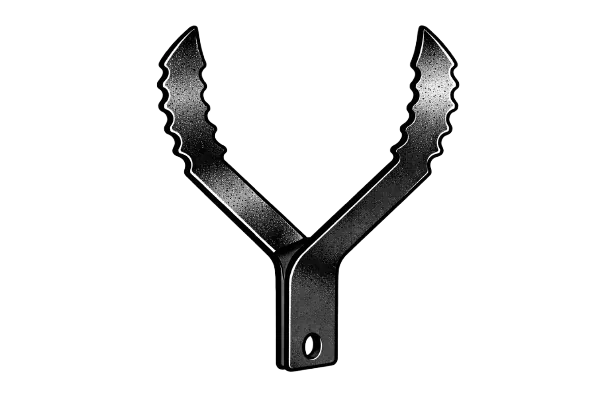
Roots are cut mechanically. A cable is advanced to the root mass with a cutting head sized to the pipe, and rotation drives the head through the roots, severing them and clearing the cross-section.
Head selection matters more here than with soft blockages. A head that only bores a narrow channel through a root mass restores drainage briefly while leaving most of the mass in place. Working closer to the pipe's own diameter removes considerably more.
Cut material is flushed onward or drawn back out. Roots are frequently bound up with grease and sludge, so some residue is usually left on the wall after cutting — and how much further that wall can reasonably be worked depends on the pipe's condition, particularly where roots entered through a defect in the first place.
What root cutting does not do
This is the part that deserves emphasis, because it is routinely glossed over.
- It does not repair the pipe. The crack, gap or damaged joint that admitted the roots is exactly as it was afterward.
- It does not close the opening. Cutting happens inside the pipe; the opening is in the pipe wall.
- It does not kill the tree or the root system. The portion inside the pipe is removed. The root outside remains alive and continues to grow.
- Regrowth should be expected. With the moisture source unchanged and the opening unchanged, roots return. How quickly depends on species, season and how thoroughly the mass was removed.
Anyone describing root cutting as a permanent fix is describing something else. What it genuinely provides is restored flow and, done thoroughly, a longer interval before the problem returns.
Why inspection afterward is often worthwhile
Once roots are cut and the line is passable, a camera can show what is actually there: where the roots are entering, how large the opening appears, whether the joint has offset, and what condition the surrounding pipe is in.
That distinction shapes what happens next. Fine roots at an otherwise sound joint is a different situation from a badly offset or cracked section, even though both present as recurring backups. Knowing which one you have is what makes it possible to plan rather than simply repeat the clearing.
What to reasonably expect
Expect to be shown or told what came back on the cable. Expect a realistic statement about regrowth rather than a promise that it is handled. Expect a clear explanation of why inspection may be worth doing once the line is open — and no pressure if the situation does not warrant it.
Ask about a recurring root problem
How often the line blocks, and whether root material has been recovered before, is useful information to start from.