
The problem this solves
Available throughout Brooklyn, for the situations where somebody other than you needs to see what was found — a contractor quoting repair work, a second opinion, or a record kept against a building whose sewer has a history.
A standard camera inspection happens in real time. The camera travels the line, the findings are explained while the screen is in front of you, and then the visit ends. For a lot of situations that works perfectly well.
It stops working when the information has to go somewhere else. A verbal explanation given at a basement cleanout is difficult to relay accurately to a contractor three weeks later, difficult to compare against a second opinion, and impossible to review once the details have faded.
Premium Sewer Diagnostics is the same inspection work, captured so it can be re-examined, shared and kept.
What the service includes
-
Full sewer camera inspection
The accessible line is inspected along its reachable length, with observations described as the camera travels.
-
Sewer line locating
The camera head transmits a signal that can be traced from above ground, establishing the approximate route the line follows.
-
Depth readings where applicable
Approximate depth at located points, where site conditions and equipment allow a reading to be taken.
-
Diagnostic screenshots
Still images captured at the points of interest identified during the survey.
-
Recorded camera video
Video of the inspection, so the run can be reviewed again rather than recalled.
-
Written PDF diagnostic report
The observations set out in writing — what was inspected, what was seen, where, and what remained uncertain.
Why documentation matters
Documented findings tend to be useful in situations like these:
- Evaluating a recurring condition. When a line has blocked several times, a record makes it possible to compare what was seen on different occasions rather than relying on memory.
- Comparing repair approaches. Different contractors may propose different work. Shared footage and a written record mean each is responding to the same observations.
- Landlords and property managers. Documenting the observed condition of a sewer at a point in time, particularly across multiple properties.
- Property evaluation. Understanding what shape a sewer is in as part of assessing a building.
- Keeping a record. A baseline that later observations can be measured against.
- Sharing with another professional. Passing what was observed to a contractor, engineer or other relevant party in a form they can actually review.
Whether a report satisfies the requirements of a particular lender, insurer, agency or legal process depends on that party's own rules. Sewer Monster cannot guarantee acceptance for any specific transaction or proceeding.
Sewer line locating
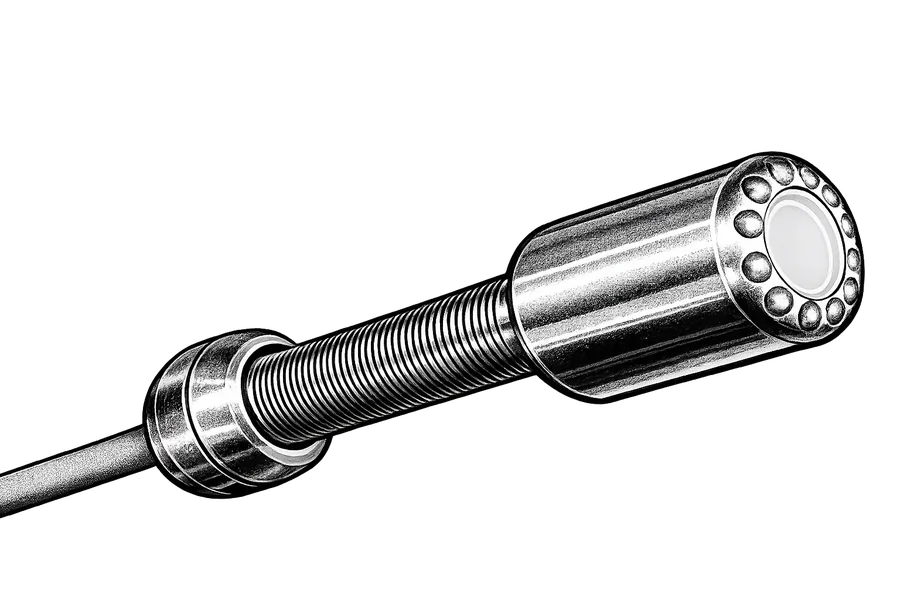
The camera head contains a transmitting sonde. A locator used above ground detects that signal, which makes it possible to establish where the camera head currently sits — and, by tracing it as the camera advances, the approximate route the line follows beneath the surface.
Where conditions and equipment permit, the locator can also give an approximate depth reading at a located point.
What locating does not do
- It does not produce a survey-grade map of an entire sewer system.
- It locates the camera head, so it can only trace pipe the camera can physically reach.
- Depth readings are approximate. Soil conditions, nearby metal, reinforcement and interference can all affect them.
- It describes where a line appears to run — not what condition the ground or the pipe is in between located points.
What the report is, and what it is not
The report is a record of what was observed during the inspection, written plainly, with the locations and the uncertainties stated.
- It is not a licensed engineer's report, and does not carry an engineering stamp or certification.
- It does not offer engineering conclusions about structural condition, soil, or the building.
- It does not guarantee the absence of conditions that could not be observed. Pipe outside the inspected length, sections the camera could not reach, and anything not visible on video are not covered by it.
- It describes observations. Where something is unclear on video, the report says so rather than resolving it.
That restraint is deliberate. A report that overstates what a camera established would be less useful, not more.
When this makes sense — and when it doesn't
It makes sense when a line has a history worth documenting, when more than one party needs to see the same evidence, when repair decisions are being weighed, or when a record of condition has value on its own.
It does not make sense for a one-off clog with an obvious cause and no history. In that situation a standard inspection, or no inspection at all, is the honest recommendation.
What to reasonably expect
Expect the line to be assessed for whether clearing is needed before inspection would show anything useful. Expect the survey to be narrated as it happens. Expect locating to be performed where the line and site allow it, and to be told plainly where a depth reading is not reliable.
Expect the documentation afterward to describe what was seen, including the parts that were inconclusive.
Ask about documented inspection
If you need the findings to remain useful after the visit, describe the situation and it will be clear whether this is the right service.