What hydro jetting actually does
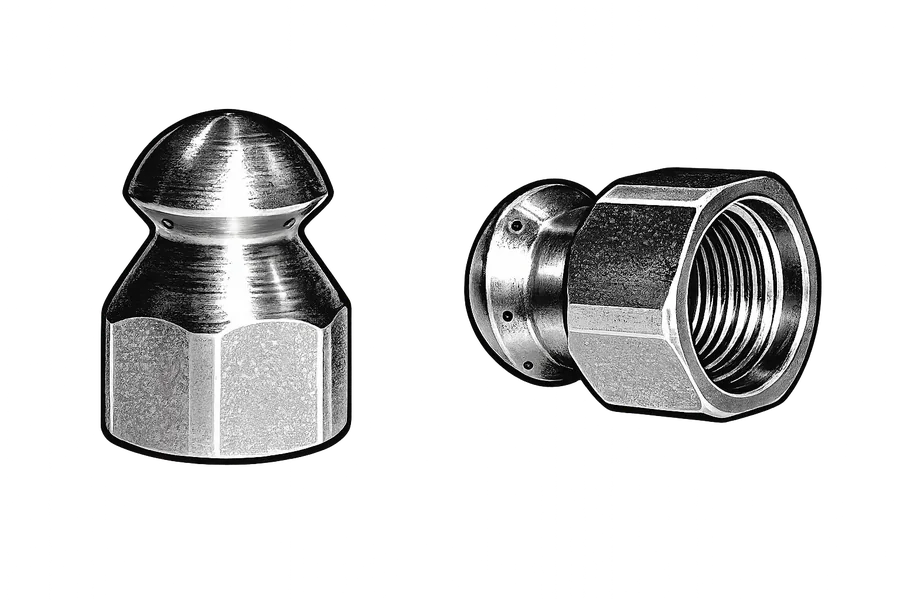
Hydro jetting — also called water jetting or sewer jetting — is a professional cleaning method. A hose carrying pressurised water is fed into the line, and a specialized nozzle at its end directs that water in specific directions: typically some forward, and several angled backward.
The rear-facing jets do two things at once. Their thrust pulls the hose along the pipe, and the water they throw against the pipe wall scours material off it as the nozzle travels. Loosened debris is carried away with the flow.
Used in suitable piping it is genuinely effective, particularly against grease, sludge and soft accumulation coating the pipe wall. That is a real strength: a cable passes through such material, while a jet removes it from the wall along a length of pipe.
Sewer Monster is not currently advertising hydro jetting as a service. This page exists because it is a question property owners ask, and the answer is genuinely useful whoever ends up doing the work.
Why pipe condition matters
Sewer lines are not interchangeable. Two pipes carrying the same waste, in buildings on the same street, can be in completely different structural condition — and a method that is entirely appropriate for one may not be appropriate for the other.
An older or previously uninspected line may contain any of the following:
- Cracks in the pipe wall, ranging from hairline to substantial.
- Broken or missing sections where the pipe no longer forms a continuous channel.
- General deterioration accumulated over decades of service.
- Fragile material — older clay, degraded cast iron, or transitions between materials that age differently.
- Weakened or questionable joints where sections meet.
- Offsets, where sections have shifted and no longer line up.
- Substantial corrosion that has thinned the pipe wall.
- Previous repairs of unknown age, method and quality.
- Areas already approaching failure that give no sign of it from above ground.
None of this is unusual. It is the ordinary condition of a lot of older drainage, and much of it is invisible to the property owner.
Can hydro jetting damage a pipe?
The honest answer has two halves, and both matter.
In sound pipe, jetting is not expected to cause damage. Pressurised water is not inherently destructive to a structurally intact sewer line, and treating it as though it were would be inaccurate. Competent operators clean a great many lines this way without incident.
The concern is compromised pipe. High-pressure water cleaning places real mechanical and hydraulic forces on the pipe it is working. Where a line already contains significant cracks, deterioration, fragile material or other structural weakness, an aggressive cleaning method can worsen an existing defect or contribute to further failure. A section already close to giving way may not survive being worked hard.
So the risk is not really about water. It is about applying an aggressive method to a line without enough understanding of what that line can take.
Why "unknown condition" is the actual problem
Here is the difficulty: a property owner generally cannot assess pipe condition from above ground, and the most intuitive test is not a reliable one.
A sewer can continue to drain while containing root openings, cracks, corrosion, offsets, weakened areas and general deterioration. Water finding its way through a pipe establishes that there is a path through it. It does not establish that the pipe is structurally sound.
This cuts both ways, and it is worth being careful here. Plenty of lines that have never been inspected are in perfectly reasonable condition. The point is not that older sewers should be assumed to be fragile — it is that the assumption runs in neither direction, and choosing an aggressive method on the basis of an assumption is where avoidable risk enters.
Where camera inspection helps — and where it stops
Looking inside an accessible line before choosing an aggressive cleaning method can provide genuinely useful information. A camera survey may show:
- Visible cracks or broken sections.
- Root intrusion, and roughly how much of the pipe it occupies.
- What material the pipe appears to be, and where it transitions to another.
- Deterioration that is apparent from inside the line.
- Offsets and questionable joints.
- Standing water, and where it sits.
- How much buildup is on the wall.
That information can meaningfully inform whether a method is reasonable for a given line.
But an inspection is evidence, not proof of soundness. A camera cannot establish that every part of a sewer is structurally sound. It shows what is visible along the length it can physically reach, and visibility is often limited — a line that is fully blocked, full of sewage, obscured by debris, or simply inaccessible will not yield a useful survey. Sometimes clearing has to happen before an inspection can show anything at all, which means the decision about how to clear is occasionally made with less information than anyone would prefer.
Being straightforward about that limit is more useful than overstating what a camera settles. What a sewer camera can and cannot see covers this in more detail.
The principle
Condition first. Method second.
The objective of drain and sewer equipment is not to apply the most aggressive tool available. It is to restore flow while understanding enough about the line to choose a method that suits it.
Different circumstances genuinely call for different approaches. A kitchen line thick with grease is a different problem from a fragile older main with roots at a cracked joint, and treating them identically because one machine is on the truck is how avoidable damage happens — with any method, not just this one.
What this means in practice
If you are weighing high-pressure cleaning for your own line, reasonable questions to ask whoever is proposing it include: what is known about this pipe's material and condition, how that was established, what the plan is if the line turns out to be in worse shape than expected, and whether a less aggressive method would achieve enough.
Those are not hostile questions. Any competent operator will have thought about them already.